Stepping onto the field at a living history event or tactical re-enactment is unlike any other hobby. For a few days, you aren’t just wearing a costume—you are honoring the memory of the soldiers who lived, marched, and fought in those exact garments.
Because authenticity matters deeply to the living history community, almost every established re-enactment unit enforces strict authenticity regulations (often called “authenticity standards”). Showing up with modern synthetic fabrics, incorrect button patterns, or poorly fitted boots won’t just ruin your immersion; it can prevent you from passing unit inspection before stepping onto the field.
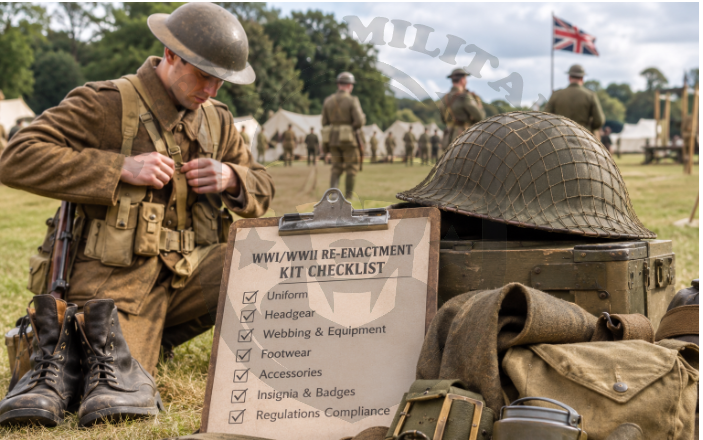
Whether you are assembling your first kit or upgrading existing gear, this WWI/WWII re-enactment kit checklist breaks down every essential layer, material standard, and regulatory detail you need to pass inspection with confidence.
Explore Museum-Grade WWI & WWII Uniform Collections (CTA Button “Explore Button”)
Understanding Re-enactment Authenticity Regulations
Before purchasing your first tunic or pair of trousers, confirm your unit’s specific theater, year, and branch of service. A British Tommy in the trenches of 1916 Somme wore drastically different gear than a U.S. GI landing in Normandy in 1944.
Across almost all Allied and Axis units, three universal rules apply:
- Zero Modern Synthetics: Polyester, nylon, and modern Velcro are strictly prohibited. Uniforms must be crafted from period-correct heavy wool serge, Melton wool, cotton twill, or HBT (Herringbone Twill).
- Accurate Hardware & Insignia: Plastic buttons where stamped brass, zinc, or vegetable ivory belong will immediately fail inspection. Hand-embroidered bullion or period-correct woven insignia must match the exact rank and division regulations of your unit.
- Proper Tailoring & Fit: Military uniforms of the World Wars were issued in standardized sizes and tailored in the field. Baggy, ill-fitting garments look modern; a crisp, historically accurate silhouette requires proper measurements. (Need help getting exact measurements? Read our Ultimate Guide to Custom-Sizing Historical Uniforms Online.)
The Essential WWI Re-enactment Kit Checklist (1914–1918)
World War I introduced industrialized warfare, requiring durable wool uniforms designed for life in muddy trenches. Whether portraying the British Expeditionary Force (BEF), the American Expeditionary Forces (AEF), or the Imperial German Army, your baseline kit requires:
- Tunic & Trousers: Heavy-weight khaki wool serge (for British/Commonwealth and U.S. Doughboys) or Feldgrau (field grey) wool for German impressions. Ensure pockets, pleats, and collar hooks match the specific pattern year (e.g., British 1902 Pattern Service Dress or U.S. M1917). (For a deep dive into specific Great War cuts, check out our guide on WWI Doughboy & Imperial German Uniform Standards.)
- Wool Puttees: Long strips of woven wool wrapped tightly from the ankle to just below the knee to support the lower leg and keep trench mud out of boots.
- Headgear: A stiffened service dress cap for walking out, paired with a steel Brodie helmet (Allied) or M1916 Stahlhelm (German) with an accurate leather liner and chinstrap.
- Webbing & Leather Gear: British and Commonwealth units require the 1908 Pattern Webbing equipment (belt, cross-straps, ammunition pouches, bayonet frog, and entrenching tool carrier), while U.S. and German troops rely heavily on vegetable-tanned leather belts and cartridge boxes.
- Footwear: Hobnailed, natural-leather ankle boots (such as the British B5 boot or U.S. Trench Boot) treated with dubbin for waterproofing.
Shop Authentic WWI Uniforms & Trench Gear (CTA Button “Explore” ) link to https://replicamilitary.com/product-category/us-army-ww1-aef-uniform/
The Essential WWII Re-enactment Kit Checklist (1939–1945)
World War II saw a dramatic evolution in military tailoring, shifting toward specialized combat uniforms, reinforced pockets, and breathable cotton fabrics for warmer theaters alongside classic wool dress and field uniforms.
- Service & Combat Jackets: Depending on your impression, select an M1941 Field Jacket, M1943 Combat Jacket, or the iconic wool “Ike” Jacket for U.S. forces; British Battledress Serge Blouse and Trousers; or a German M36/M40/M43 Feldbluse.
- Shirts & Undershirts: Period-accurate mustard wool flannel shirts (U.S.), collarless grey-green cotton shirts (British), or Trikot knit undershirts. Modern white crew-neck T-shirts visible at the collar are a common rookie mistake.
- Combat Trousers & Gaiters: Wool serge or OD7 cotton sateen trousers paired with canvas leggings (U.S. M1938 dismounted leggings) or short webbing anklets (British).
- Field Gear & Load-Bearing Equipment: Heavy-duty cotton canvas pistol belts, M1923 cartridge belts, canteen covers, first-aid pouches, and musette bags or haversacks.
- Footwear: Roughout leather service shoes, double-buckle combat boots, or jump boots (for airborne impressions) with authentic stitched soles.
Browse Custom-Tailored WWII Uniforms (CTA Button ” Explore”) link to https://replicamilitary.com/product-category/ww2-british-army-uniform/
Personal & Camp Items (The Details That Set You Apart)
Once your core uniform and webbing pass inspection, small personal items elevate your impression during downtime at living history camps:
- Mess Kit & Canteen: Aluminum or stainless steel period-dated mess tins, canteen cup, and cutlery.
- Dog Tags / Identity Discs: Stamped with accurate period fonts, serial numbers, and blood types.
- Personal Grooming & Field Kit: Bakelite or metal safety raz or, boar-bristle shaving brush, wool blanket, and a period-correct sewing kit (“housewife”) for field repairs.
Why Custom Tailoring & Museum-Grade Materials Matter
Off-the-rack mass-produced costumes often cut corners using thin, shiny fabric blends and generic sizing that bunches awkwardly under heavy webbing. At Replica Military, every uniform is hand-crafted by master tailors using heavy-weight, custom-dyed wools, authentic cotton twills, and period-accurate hardware.
Whether you are outfitting yourself for an upcoming tactical event or sourcing historical wardrobe for a film production, investing in museum-grade construction ensures your uniform ages naturally, withstands harsh field conditions, and earns respect from fellow historians.
Order Your Custom-Sized Re-enactment Uniform Today (CTA Button “Contact”)link to https://replicamilitary.com/contact-us/
Frequently Asked Questions (FAQs)
1. What fabrics are required for authentic WWI and WWII re-enactment uniforms?
Most re-enactment units strictly prohibit modern synthetic fabrics like polyester or nylon. Authentic uniforms must be constructed from heavy-weight wool serge, Melton wool, cotton herringbone twill (HBT), or heavy cotton canvas, depending on the specific nation, branch, and theater of war.
2. How should a historical military uniform fit compared to modern clothing?
WWI and WWII uniforms were worn with high-waisted trousers (often reaching the natural navel and held up with braces/suspenders) and tailored tunics designed to sit cleanly beneath heavy leather or canvas load-bearing webbing. Ordering custom-tailored measurements guarantees a sharp, period-authentic silhouette.
3. Can I mix gear from different years of the war in one impression?
Generally, no. Unit authenticity regulations require your uniform, insignia, and webbing to match a specific year and battle (for example, avoiding late-war M1943 gear in an early-war 1942 North Africa event). Always check your unit’s velocity/timeline guidelines before ordering.
4. How long does it take to receive a custom-tailored reproduction uniform?
Because museum-grade reproductions are cut, stitched, and finished to your exact body measurements—including custom rank insignia and piping—custom tailoring typically takes between 3 to 5 weeks prior to shipping.