Stepping onto a living history field requires more than just wearing old-style clothes—it demands historical accuracy down to every stitch, button, and weave. For living historians portraying the American Expeditionary Forces (AEF) during the pivotal years of 1917–1918, recreating an accurate WW1 reenactment uniform is essential to honoring the doughboys who served on the Western Front.
Whether you are building your first kit or upgrading to museum-grade gear, this WW1 AEF uniform guide breaks down every layer of clothing, equipment, and field gear needed to achieve a period-correct late-war appearance.
The Anatomy of the 1917–1918 US Army Doughboy Impression
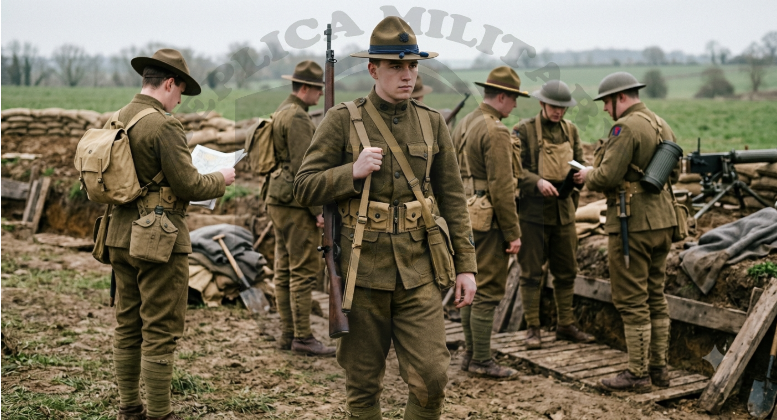
When the United States entered World War I in 1917, the Army’s standard service dress underwent rapid changes due to mass production requirements and harsh trench warfare conditions. To assemble an authentic late-war kit, focus on these fundamental items:
- M1917 Service Wool Tunic (Coat): The centerpiece of your uniform. Look for olive drab (OD) wool with stand-up collars, five rimmed bronze button closures, and four patch pockets.
- M1917 Wool Breeches: Tailored tight at the lower leg to fit inside puttees, featuring reinforced knee patches and laced or buttoned lower legs.
- Olive Drab Wool Puttees (Leg Wrappings): Crucial for ankle support and keeping trench mud out of your boots. Proper spiral wrapping from ankle to knee is vital for an authentic look.
- Pershing Boots / Trench Boots: High-quality leather footwear with hobnailed soles and reverse-leather construction to withstand mud and moisture.
- M1905 / Overseas OD Cap: Depending on your unit’s location—stateside training vs. active service in France—you will need either the classic peak hat or the foldable Overseas Cap.
To view museum-quality, hand-stitched reproductions built from archival patterns, explore our collection of US Army WW1 AEF Uniforms.
Essential Webbing & Field Gear
A complete US Army WW1 reproduction isn’t finished with just clothing—your field equipment brings the doughboy profile to life:
| Gear Item | Purpose & Historical Detail |
| M1910 Cartridge Belt | Holds ten 5-round stripper clips for the M1903 Springfield or M1917 Enfield rifle. |
| M1910 Haversack | The primary back pack storing mess kits, rations, shelter halves, and rain ponchos. |
| M1910 Canteen & Cover | Aluminum canteen housed in a fleece-lined felt cover to keep water cool in the field. |
| M1917 Doughboy Helmet | The iconic British-designed “Brodie” helmet produced under American contracts. |
If you are just getting started and want a complete, ready-to-wear kit, check out our all-in-one WW1 US AEF Uniform Combo Pack to get your tunic, breeches, and accessories matching perfectly.
Key Tips for Historical Accuracy in WW1 Reenacting
- Get the Drape and Fit Right: Original military uniforms were fitted loosely across the body for movement, but tailored tight at the calves. Custom sizing is key to achieving the correct silhouette.
- Weathering Your Kit: Fresh-out-of-the-box wool looks out of place in trench scenarios. Lightly wear and age your wool and leather gear to reflect field conditions.
- Know Your Unit’s Timeline: A unit serving in late 1918 at the Meuse-Argonne Offensive carried slightly different gas mask bags and equipment than troops arriving in late 1917.
Interested in how allied uniforms compared on the Western Front? Read our companion guide on British Army WW1 Uniforms and Equipment or explore our historical breakdown of WW1 Imperial German Uniforms & Trench Gear.
Frequently Asked Questions (FAQ)
Q1: What wool weight was used in original 1917–1918 US Army uniforms?
Original WW1 US Army tunics and breeches were made from a heavy 16–18 oz olive drab wool fabric. This provided durability and warmth in northern European trench environments.
Q2: How do you wrap WW1 wool puttees correctly?
Start at the ankle (just above the boot top), wrap tightly upward around the calf in overlapping spirals, and finish just below the knee. Secure the attached cotton tape by wrapping it around and tucking the end under.
Q3: Can I wear an M1917 overseas cap for early 1917 impressions?
No. The Overseas Cap was introduced after AEF troops arrived in France in late 1917 to replace the bulky Campaign Hat for front-line duty. For early 1917 stateside impressions, the Campaign Hat is accurate.
Q4: How should I care for and clean a wool WW1 reproduction uniform?
Because reproduction uniforms are made from genuine wool, they should be dry-cleaned or spot-cleaned with cold water. Avoid hot water washing or machine drying to prevent shrinkage.
Q5: What is the difference between M1903 Springfield and M1917 Enfield ammo pouches?
The standard M1910 cartridge belt held 10 pockets designed to carry clips for both the M1903 Springfield and M1917 Enfield rifles interchangeably.