Imperial German Tunics Compared: M1907/10 Feldrock vs. M1915 Bluse
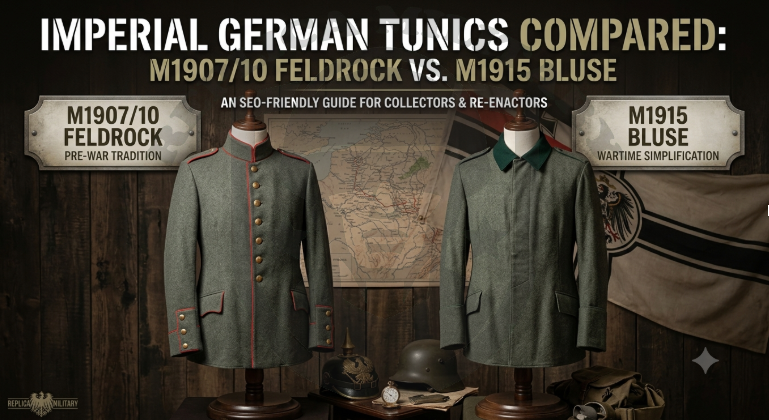
At the outbreak of World War I in 1914, the Imperial German Army marched onto the Western and Eastern Fronts wearing one of the most distinctive field uniforms in modern history: the M1907/10 Feldrock. However, as the conflict turned into brutal trench warfare, wartime economy and tactical visibility forced significant design changes, culminating in the streamlined M1915 Bluse.
For military historians, re-enactors, and collectors, understanding the exact structural differences between these two iconic tunics is essential for setting up an accurate Great War impression.
Key Technical Differences At a Glance
| Feature | M1907/10 Feldrock (Pre-War / Early War) | M1915 Bluse (Mid-to-Late War) |
| Primary Color | Field Grey (Feldgrau) with prominent piping | Muted Field Grey with simplified turned-down collar |
| Buttons | Exposed brass or tombac crown buttons | Covered fly front (hidden buttons to reduce glare) |
| Cuffs | Regimental cuffs (Brandenburg, Swedish, or Saxon) | Simplified barrel cuffs with turn-back capability |
| Collar Detail | Stand-and-fall collar with bright branch piping | Dark green or simplified feldgrau collar |
The Evolution on the Western Front
1. The M1907/10 Feldrock: Ornamental Tradition
The M1907/10 was tailored to reflect German military prestige. It featured colored piping along the front fly, collar, and cuffs to identify specific regiments and corps. However, brightly polished brass buttons and red piping proved dangerous under sniper observation in the trenches of Flanders.
2. The M1915 Bluse: Tactical Simplified Utility
Introduced in late 1915, the Bluse was designed for rapid wartime mass production and tactical camouflage:
- Hidden Fly Front: Covered the main buttons behind a wool flap to prevent reflections and avoid snagging on barbed wire.
- Universal Tailoring: Simplified cuff constructions eliminated complex regimental piping, standardizing production across Bavarian, Prussian, and Saxon units.
Building Your Imperial German Re-enactment Kit
Achieving historical accuracy requires pairing your tunic with correct Great War uniform pieces:
- Upper Garments: Match your tunic with our museum-grade WW1 M1915 Imperial German Soldier Tunic.
- Cold Weather Outerwear: For trench impressions during winter conditions, layer with the heavy wool Reproduction WW1 P07/10 Imperial German Soldier Overcoat.
- Complete Outfits: To save on full gear sets, order the complete WW1 Imperial German Uniform Combo Pack.
Explore the entire WW1 Imperial German Collection for hand-tailored tunics, trousers, and insignia.
Frequently Asked Questions (FAQs)
Why did the Imperial German Army change from brass to tombac/painted buttons?
Shiny brass buttons reflected sunlight in open fields, making soldiers easy targets for enemy marksmen. Later wartime iterations used painted or field-grey crowned buttons hidden behind a cloth fly.
Can I wear an M1915 Bluse for a 1914 Western Front impression?
No. For early-war campaigns (1914 to mid-1915), the M1907/10 Feldrock is required. The M1915 Bluse became standard issue from late 1915 through the end of the war in 1918.
How are Replica Military German tunics tailored?
Our tunics are hand-tailored using heavy wool blends based directly on archival patterns, complete with authentic internal shoulder padding, belt hook support holes, and period-accurate linings.