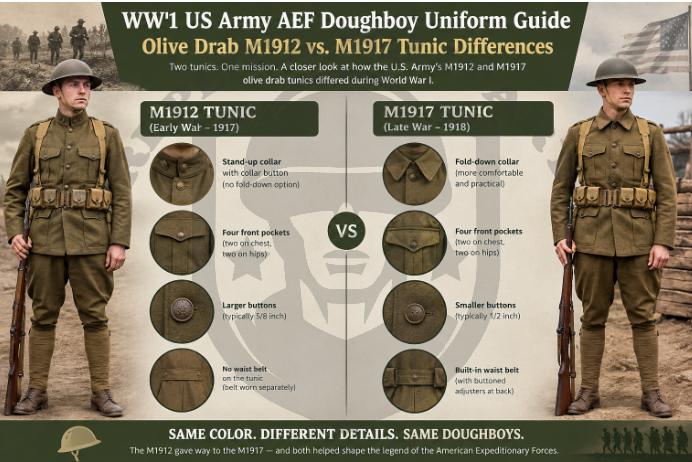
When the American Expeditionary Forces (AEF) entered World War I in 1917, American “Doughboys” marched onto European soil in distinct Olive Drab wool uniforms. However, reenactors and historical collectors quickly discover that not all AEF service coats were identical.
To build an accurate WW1 impression, understanding the transition from the pre-war M1912 Wool Service Coat to the simplified M1917 Wartime Tunic is essential.
Historical Context: Pre-War Elegance vs. Mass Production
Before 1917, the U.S. Army was a small professional force equipped with carefully tailored wool garments. When industrial mobilization began, quartermasters realized the pre-war tunic took too long to produce.
[ M1912 Wool Service Tunic ]
• Bellows Pockets with Pointed Flaps
• Intricate Interior Lining & Collar Trim
│
▼ (Wartime Mass Production Streamlining)
│
[ M1917 / M1918 Simplified Tunic ]
• Flat Patch Pockets
• Unlined, Coarser Olive Drab Wool
Key Technical Differences: M1912 vs. M1917 Tunic
| Feature | M1912 Service Coat | M1917 / M1918 Simplified Tunic |
| Pocket Style | Bellows pockets (expandable) with scalloped flaps | Flat patch pockets to conserve fabric and sewing time |
| Collar | High standing collar with metal disk insignia | Standing collar, often slightly lower or relaxed |
| Fabric & Shade | Finer grade Olive Drab (OD) wool | Coarser wool; shade varies from mustard-olive to brown-drab |
| Interior Lining | Full or partial interior cotton lining | Unlined or minimal lining for rapid factory production |
| Production Context | Regular Army pre-war production | Emergency mobilization mass manufacturing |
How AEF Uniforms Compared to Allied & Central Powers Gear
When Doughboys arrived in Europe, their uniforms stood in contrast to both Allied partners and adversaries on the Western Front:
- British & Commonwealth Forces: While the US army favored standing collar tunics, British forces wore functional fold-down collars on the classic British WW1 SD Service Dress Tunic. Collectors comparing Allied designs often study WW1 British military uniforms to understand the influence of British webbing and wool production on arriving American units.
- Commonwealth Divisions: Similar functional wool construction was seen in Australian units, leading many militaria enthusiasts to explore Buy WW1 Australian Army Uniforms for comparative displays.
- Opposing Imperial German Forces: Across No Man’s Land, the German army wore field-grey (Feldgrau) tunics. If you collect Central Powers militaria alongside Allied gear, explore authentic options for WW1 Imperial German Uniforms to see how European tailoring adapted to trench conditions.
Complete Doughboy Equipment Checklist
To complete your AEF impression beyond the tunic, you need period-correct equipment:
- M1912 / M1917 Olive Drab Wool Breeches: High-waisted trousers designed to tuck neatly into leg wrappings.
- Wool Puttees (Leg Wraps): Spiral-wrapped wool bandages worn around the lower leg for support and mud protection.
- M1910 Canvas Webbing: Cartridge belts, canteen covers, and haversacks.
- M1917 Enfield or M1 helmet: Derived directly from the British Brodie helmet design.
Tips for Sourcing and Caring for Reproduction Uniforms
Whether you are assembling a US Doughboy impression, looking to buy world war 2 uniforms, or sourcing historical apparel in quantity, purchasing accurate wool reproductions is essential.
If you represent a historical reenactment group, theater company, or museum production, you can order from a dedicated WW1 army uniform manufacturer or explore ww1 army uniform bulk purchasing for unit outfit discounts.
Frequently Asked Questions
Q. What is the primary difference between the M1912 and M1917 Doughboy tunic?
Ans. The M1912 tunic features standing collar bellows pockets with distinct pointed flaps and intricate interior tailoring. The M1917 simplified tunic removed bellows pockets and used flat, patch-style pockets to speed up mass production during wartime mobilization.
Q. What color was the American Expeditionary Forces (AEF) tunic?
Ans. AEF tunics were made from Olive Drab (OD) wool, which varied in shade from mustard green-brown to dark drab, depending on the wool mill and dye batch.
Q. Did British-made uniforms influence US AEF gear?
Ans. Yes, many US troops arriving in France were issued British-manufactured simplified tunics or modified coats tailored by Allied factories due to early supply shortages.