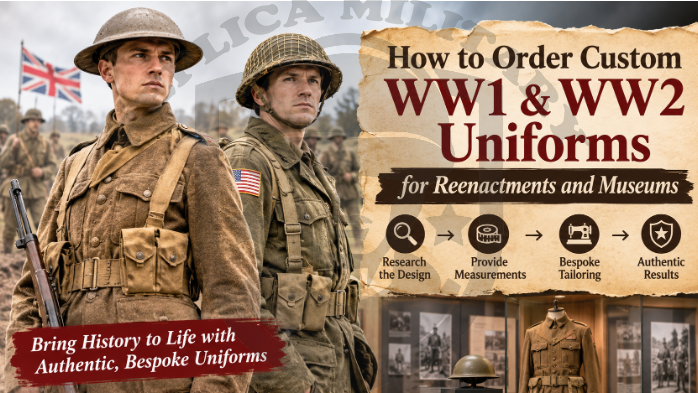
Recreating a moment in military history requires more than wearing an old-fashioned uniform. Whether you are preparing for a World War I battlefield reenactment, developing a museum exhibition, organising a living-history event, or producing a historically themed film, the uniform plays an essential role in bringing the past to life.
Every button, stitch, collar, pocket, fabric choice, and insignia contributes to the historical story being represented.
However, finding a uniform that genuinely reflects a particular military period, regiment, country, and rank can be challenging. Standard military-style costumes may look convincing from a distance, but they often lack the construction details, materials, proportions, and historical accuracy required by serious reenactors and museums.
This is where custom WW1 and WW2 uniform reproductions make a difference.
Through bespoke tailoring, historical references, carefully selected materials, and attention to period-specific details, a specialist uniform manufacturer can transform historical designs into wearable reproductions.
In this guide, we explain how to order custom WW1 and WW2 uniforms, what information you should prepare, how the bespoke manufacturing process works, and what separates an authentic reproduction from an ordinary military-style costume.
Why Choose Custom WW1 and WW2 Uniforms?
Military uniforms changed significantly between the First and Second World Wars. Different armies, regiments, ranks, and operational environments required distinctive clothing designs.
For example, a British soldier’s WW1 Service Dress uniform was considerably different from a WW2 British Battle Dress uniform. Similarly, American, German, French, Australian, and Belgian military uniforms featured different cuts, fabrics, insignia, and equipment arrangements.
A standard costume might reproduce the general appearance of a military uniform, but it may not accurately represent these differences.
Custom-made historical uniforms offer several advantages:
· Historical accuracy: Reproduction based on specific military patterns, archival photographs, and historical references.
· Bespoke measurements: Tailoring that considers the wearer’s measurements and intended fit.
· Period-specific materials: Fabric selection that reflects the appearance, texture, and weight of the original garments.
· Authentic detailing: Correct buttons, pockets, collars, stitching, insignia placement, and other construction features.
· Custom requirements: Options for specific regiments, ranks, countries, military branches, and historical periods.
· Consistency for groups: Coordinated uniforms for reenactment teams, museum displays, and historical organisations.
For museums and serious living-history enthusiasts, these details are important because a uniform is not simply clothing. It is part of the historical interpretation.
Understanding the Difference Between Standard and Authentically Built Military Uniforms
One of the most important decisions when ordering historical military clothing is understanding the difference between a standard military-style costume and an accurately constructed historical reproduction.
1. Historical pattern and construction
Standard uniforms are often manufactured using modern generic patterns designed to create a military-inspired appearance. Authentically built reproductions, on the other hand, are developed around historical garment references. Their proportions, pocket arrangements, collar shapes, seam construction, and overall silhouette are considered in relation to the original period. For example, reproducing a WW1 British Service Dress tunic requires attention to its characteristic design rather than simply manufacturing a modern khaki military jacket.
2. Fabric selection
Fabric is one of the biggest differences between a costume and a quality historical reproduction. Standard costumes may use inexpensive synthetic blends that have a noticeably different appearance and feel from historical military garments. A specialist manufacturer considers fabric weight and texture, period-appropriate colour and finish, durability for repeated reenactment use, suitability for indoor museum displays, and the visual characteristics of the original material. Where original fabric is unavailable, an appropriate modern substitute may be selected to reproduce the historical appearance as closely as practical.
3. Buttons, insignia, and accessories
A uniform’s smaller details can make a significant difference to its historical accuracy. Standard costumes may use generic buttons, modern badges, or incorrectly positioned insignia. A historically researched reproduction considers the relevant military branch, regiment, rank, and period when selecting and positioning these details. Depending on the design, this may include period-style military buttons, shoulder titles and rank insignia, collar badges, cuff and pocket detailing, belt arrangements, and period-appropriate accessories.
4. Tailoring and fit
Standard costumes are generally produced in predetermined sizes. Bespoke military uniforms can be developed using individual measurements and specific fit requirements. This is particularly useful for reenactors who need freedom of movement or museum projects that require consistent sizing across several garments.
5. Historical purpose
The intended use also influences the manufacturing approach. A uniform designed for a museum mannequin may prioritise visual accuracy and display presentation, whereas a reenactment uniform must also consider comfort, mobility, and repeated use. The best reproduction is therefore not simply the one that looks old. It is the one that reflects the historical design while meeting its intended purpose.
Step-by-Step: How to Order Custom WW1 and WW2 Uniforms
Ordering a custom historical uniform becomes easier when you follow a structured process. Providing the right information at the beginning helps the manufacturer understand your requirements and minimise unnecessary revisions.
Step 1: Identify the Historical Period and Military Force
Start by identifying exactly which uniform you need. Avoid simply requesting a WW1 or WW2 military uniform. These periods include numerous countries, military branches, regiments, and uniform variations. Your initial brief should specify the historical period (WW1 or WW2), country or military force, army, navy, air force, or other branch where applicable, regiment or unit, rank or role, and approximate year or campaign if known. For example, your requirement could be a WW1 British Army Service Dress tunic, a WW1 Imperial German uniform, or a WW2 British military uniform. The more specific your request, the easier it becomes to identify the appropriate historical design.
Step 2: Collect Historical References and Design Details
The next step is to establish how the original uniform looked. Useful references include historical military photographs, museum collections and archived garments, military uniform manuals, original garment patterns, period illustrations, and reliable historical publications. If you already have a reference photograph, share it with the manufacturer. Try to provide front, back, and side views whenever possible. Close-up images of collars, buttons, pockets, cuffs, shoulder straps, and insignia are especially useful. If your project involves a particular regiment or officer’s uniform, include the relevant identifying details. Expert tip: Do not rely on a single photograph when reproducing a complex uniform. Different versions of the same military garment may have existed across different years and operational settings.
Step 3: Select the Uniform Components
Decide whether you require a complete uniform or individual garments. Depending on the historical design, your order may include military tunics and jackets, trousers or breeches, greatcoats and overcoats, shirts and undershirts, caps and military headwear, belts and webbing equipment, leather accessories, and rank insignia and unit-specific details. For example, a complete WW1 British Army impression may require a Service Dress tunic, appropriate trousers, headwear, and associated equipment. Explore the WW1 British Army uniform collection: https://replicamilitary.com/product-category/ww1-british-army-uniform/
Step 4: Provide Accurate Body Measurements
Bespoke tailoring depends on accurate measurements. A manufacturer may request chest circumference, waist circumference, shoulder width, sleeve length, back length, neck circumference, trouser waist, hip circumference, inside leg measurement, and height. Measurements should be taken carefully using a flexible measuring tape. For reenactment uniforms, it is also useful to explain whether you intend to wear the uniform over a shirt, waistcoat, sweater, or other period clothing. This helps the tailor account for layering and movement. For museums, provide mannequin measurements or the required garment dimensions where applicable.
Step 5: Discuss Fabric, Colour, and Construction
Once the design and measurements are established, discuss the materials and manufacturing details. Important considerations include fabric composition, fabric weight, colour matching, stitching and seam construction, button materials and finishes, pocket shape and positioning, lining and internal construction, and reinforcement in high-wear areas. Historical accuracy does not always mean using the exact original material. In some cases, modern materials may be necessary because historical fabrics are difficult to source or unsuitable for the intended use. The objective is to select materials and construction methods that reproduce the original appearance while meeting the practical requirements of the project.
Step 6: Confirm Insignia and Customisation
Insignia is one of the most important elements of military uniform reproduction. Before production, confirm regiment or unit identification, rank, shoulder titles, collar badges, buttons and other metal fittings, colour and placement of insignia, and any special identification or personalisation. For museums, it is especially important to verify these details against reliable historical references. Incorrect insignia can change the historical identity of an otherwise well-made uniform.
Step 7: Approve the Design and Production Details
Before manufacturing begins, review the agreed specifications. Your confirmation should cover uniform pattern and historical period, measurements and sizing, fabric and colour, buttons and insignia, accessories included in the order, quantity required, estimated production timeline, and shipping and delivery arrangements. For larger museum or reenactment group orders, request a clear specification for every garment. This reduces the risk of receiving uniforms with inconsistent patterns, colours, or detailing.
Step 8: Quality Inspection and Final Delivery
Once manufacturing is complete, the uniforms should be inspected against the approved specifications. Important quality checks include overall silhouette and proportions, stitching and seam finishing, button placement, pocket dimensions and positioning, correct insignia placement, measurement accuracy, fabric finish and colour consistency, and completeness of accessories. For museum orders, check the entire collection for consistency before installation. For reenactors, ensure that the uniform provides a practical fit for the intended activities.
Custom WW1 Uniforms: What Should You Consider?
World War I uniforms varied considerably between participating nations and military forces. A British soldier’s Service Dress tunic, an Imperial German field uniform, and a French Army uniform each featured distinctive characteristics. When ordering custom WW1 uniforms, pay attention to the following details.
WW1 British Army Uniforms
British WW1 uniforms are particularly recognised for their khaki Service Dress design. Important elements may include Service Dress tunic construction, stand-and-fall collar design, front button arrangement, chest and lower pockets, shoulder straps, period-specific insignia, and appropriate trousers and equipment. Explore our WW1 British Army uniform collection: https://replicamilitary.com/product-category/ww1-british-army-uniform/
WW1 Imperial German Uniforms
German military clothing during WW1 included different tunic designs and equipment variations. The correct reproduction depends on the specific year, military role, and historical reference. Collar construction, buttons, shoulder straps, field-grey appearance, and unit-specific details should be considered carefully.
WW1 French and Australian Uniforms
French and Australian military uniforms also featured distinctive national and service-specific characteristics. When ordering these reproductions, confirm the exact pattern and period rather than relying on a generic WW1 military design.
Custom WW2 Uniforms: Important Historical Details
World War II introduced further changes in military clothing, materials, and operational requirements. Different armies developed uniform systems suited to their military roles and environments.
When commissioning a WW2 reproduction, consider country and military branch, uniform pattern and production period, field, service, or ceremonial use, jacket and trouser construction, insignia and rank identification, headwear and equipment, and appropriate fabric and colour.
A WW2 British Battle Dress reproduction, for example, should not be confused with a WW1 British Service Dress tunic. Likewise, a German military uniform reproduction should be based on the correct historical pattern and intended military role. Clear historical references help avoid mixing details from different periods.
Special Considerations for Museums and Reenactment Organisations
For Museums
Museum projects may require multiple uniforms representing different military roles, ranks, or historical periods. Consider historical documentation for every design, consistency across multiple garments, mannequin-specific measurements, display requirements and presentation, material durability and maintenance, and correct identification of uniforms and accessories. If the project is intended for an educational exhibition, historical accuracy should take priority over decorative modifications.
For Reenactment Groups
Reenactment uniforms must combine historical appearance with practical usability. Consider comfort during extended wear, freedom of movement, appropriate layering, fabric durability, consistency across group members, and compatibility with period equipment. For larger orders, it is helpful to establish one approved design specification before individual uniforms enter production.
Common Mistakes to Avoid When Ordering Historical Military Uniforms
1. Ordering without identifying the exact pattern
A generic request for a WW2 uniform may result in a design that does not match your intended military force or period.
2. Using incomplete historical references
One photograph may not show the correct back construction, insignia, or pocket arrangement.
3. Ignoring measurements
Incorrect measurements can affect both appearance and comfort.
4. Mixing historical periods
Combining WW1 and WW2 details can create an inaccurate reproduction.
5. Overlooking accessories
Belts, buttons, caps, insignia, and webbing may be essential to completing the intended impression.
6. Not confirming specifications before production
Always establish the design, materials, measurements, and included components before approving the order.
Why Choose Replica Military for Historical Uniform Reproductions?
Finding a manufacturer that understands the difference between ordinary military-style clothing and historical uniform reproductions is an important part of the process.
Replica Military focuses on historical military uniform reproductions for collectors, reenactors, and organisations looking to recreate military clothing from earlier periods.
Whether you are researching a WW1 British Army Service Dress uniform, an Imperial German military uniform, or a WW2 British uniform, clearly communicating your historical references and requirements is the first step towards the right reproduction.
For individual requirements, group orders, or museum projects, discuss your specifications directly with the team.
Explore the Replica Military uniform collections: https://replicamilitary.com/product-category/ww1-british-army-uniform/
Wholesale enquiry page: https://replicamilitary.com/wholesale/
Planning a custom WW1 or WW2 uniform order?
Share your historical reference images, required uniform pattern, measurements, quantity, and intended use with Replica Military.
Contact Replica Military: https://replicamilitary.com/contact-us/
Take the first step towards bringing a piece of military history to life.
Frequently Asked Questions
1. Can I order custom WW1 and WW2 uniforms for reenactments?
Yes. Custom historical uniform reproductions can be commissioned for reenactment events, living-history displays, collectors, and other historical projects. Share the required military period, country, uniform pattern, measurements, and reference images before placing an order.
2. What information do I need to provide when ordering a custom military uniform?
You should provide the historical period, country, military branch, regiment or unit, rank, reference photographs, body measurements, fabric preferences, and required accessories. More detailed specifications help achieve a closer historical reproduction.
3. What is the difference between a standard military costume and an authentic uniform reproduction?
A standard military costume generally focuses on appearance, while a historically researched reproduction considers period-specific patterns, fabric characteristics, garment construction, buttons, insignia, and tailoring details. The level of historical accuracy depends on the references and specifications used.
4. Can museums order multiple historical military uniforms?
Yes. Museums and historical organisations can discuss requirements for multiple garments representing different periods, military branches, ranks, and units. It is advisable to establish approved specifications for each uniform before production.
5. Can a WW1 or WW2 uniform be made using my historical reference photograph?
Reference photographs can help guide the reproduction process. Ideally, provide multiple views and close-up images of important features such as collars, buttons, pockets, insignia, and stitching.
6. Are custom military uniforms made according to individual measurements?
Bespoke uniform orders can be developed around individual body measurements and fit requirements. Confirm the measurement process and sizing specifications with the manufacturer before production.
7. How long does it take to manufacture a custom WW1 or WW2 uniform?
Production time depends on the complexity of the design, material availability, customisation, quantity, and manufacturing requirements. Request an estimated production and delivery timeline when confirming your order.
8. Can I order complete military uniforms with accessories?
Depending on the historical design and availability, an order may include tunics, trousers, coats, caps, belts,
webbing, insignia, and other accessories. Confirm exactly which components are included in the quotation.
9. Which is better for reenactments: standard-size or bespoke military uniforms?
Standard-size uniforms may suit straightforward requirements, while bespoke tailoring can be useful when accurate fit, layering, specific measurements, or unusual sizing is important. The best option depends on your intended use and requirements.
10. How can I request a quotation for custom historical uniforms?
Contact Replica Military through its contact page and share the uniform type, historical references, quantity, measurements, and intended use. This information helps the team understand your project and discuss the next steps.
4. Canonical Tag
Add this inside the HTML <head> section of the new blog page. Use the canonical URL only if the article is published at the suggested slug; update it if WordPress generates a different permalink.