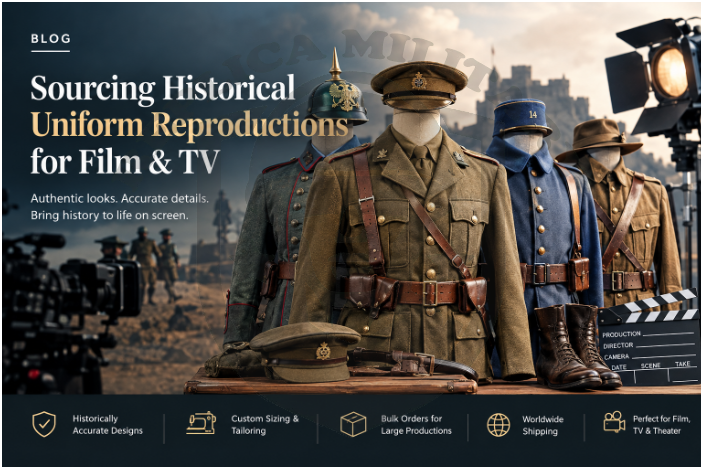
A period film can have exceptional cinematography, compelling performances, and a beautifully recreated historical setting. Yet one visibly inaccurate uniform can break the illusion for an audience that knows its history.
For film producers, television directors, costume designers, and theater production teams, sourcing historically accurate military uniforms is about much more than finding clothing that looks old. Every tunic, button, insignia, belt, cap, and boot contributes to the credibility of the character and the historical period being portrayed.
Whether you are producing a World War I battlefield drama, a World War II documentary, a historical television series, or a theatrical production, choosing the right historical uniform reproductions for film, TV, and theater productions can make a meaningful difference to the final result.
However, production teams frequently face practical challenges: limited sourcing time, inconsistent sizing, unavailable historical designs, tight costume budgets, and the difficulty of coordinating multiple uniforms for an entire cast.
This guide explains how to overcome these challenges, identify a reliable military uniform supplier, and source reproduction uniforms that meet the creative, historical, and logistical requirements of your production.
Why Historical Accuracy Matters in Film, Television, and Theater
Historical costumes help audiences understand a character’s nationality, military role, rank, and historical setting without lengthy explanations.
A British infantryman’s uniform from the First World War should not be confused with a Second World War British battledress. Similarly, an Imperial German Army tunic requires different details from a French or Australian military uniform of the same era.
Even subtle differences in fabric, cut, collar design, insignia placement, and equipment can influence how convincing a costume appears on screen or stage.
Accurate reproductions are particularly valuable for:
- Feature films: Creating visually convincing historical battle scenes and character portrayals.
- Television series: Maintaining consistent costumes across episodes, reshoots, and multiple filming locations.
- Theater productions: Ensuring recognizable period silhouettes under stage lighting and from a distance.
- Documentaries and educational productions: Supporting historically grounded visual storytelling.
- Historical reenactments and museum displays: Presenting period clothing and equipment with greater attention to detail.
The objective is to achieve a balance between historical authenticity, actor comfort, durability, and production practicality.
Common Challenges When Sourcing Historical Military Uniforms
Before selecting a supplier, it helps to understand the problems that can delay costume departments or compromise production quality.
1. Finding the Correct Uniform for the Historical Period
Military clothing evolved considerably during both World Wars. Uniforms could vary according to the year, branch of service, rank, regiment, climate, and operational environment.
A generic military-style jacket may work for a fictional setting, but it may not satisfy the requirements of a historically specific production.
For example, a costume department researching WW1 British military uniforms may need to distinguish between service dress, officers’ variations, and other period-specific garments. A production featuring German soldiers may require a carefully researched Imperial German uniform rather than a later German military design.
How to solve this: Establish the production’s exact historical timeframe and character requirements before requesting quotations. Where possible, share archival photographs, museum references, costume sketches, and known uniform specifications with your supplier.
2. Sourcing Multiple Uniforms in Different Sizes
Productions often need several versions of the same uniform for actors with different body measurements. Lead actors may require individually fitted garments, while supporting casts and background performers may need coordinated costumes in larger quantities.
Standard sizing alone may not be sufficient, especially when the costume must accommodate period layering or a specific historical silhouette.
How to solve this: Work with a supplier that offers custom sizing or bespoke tailoring. Submit measurements early, confirm the size chart, and request clarification about tailoring lead times before finalizing your production schedule.
3. Maintaining Consistency Across the Cast
A scene featuring dozens of soldiers can look inconsistent if uniforms have noticeably different shades, silhouettes, button arrangements, or insignia placement.
These differences may become especially obvious in close-ups, wide battlefield shots, and scenes filmed across multiple days.
How to solve this: Create a costume specification sheet that documents the selected uniform design, fabric, colors, accessories, rank details, and approved reference images. Order and inspect a representative sample before confirming a larger requirement.
4. Managing Tight Production Budgets and Deadlines
Film and theater schedules rarely leave unlimited time for costume sourcing. Late deliveries, incorrect sizes, or missing accessories can result in expensive alterations and reshoots.
International sourcing can also introduce additional shipping, customs, and delivery considerations.
How to solve this: Request a complete quotation covering garment costs, customization, accessories, shipping, and estimated delivery timelines. Confirm whether the supplier can accommodate bulk orders and staged deliveries when your production schedule requires them.
Which Historical Uniform Reproductions Might Your Production Need?
The correct choice depends on your script, historical setting, characters, and costume design brief. The following examples illustrate how to approach different sourcing requirements.
WW1 British Military Uniforms
Productions set during the First World War may require British infantry service dress, officers’ uniforms, period-appropriate headwear, webbing, puttees, and other supporting equipment.
A British WW1 SD Service Dress Tunic may be relevant when recreating a specific British service-dress appearance. However, the final selection should be based on the character’s service, rank, and the period depicted.
Explore relevant products: WW1 British Army Uniform and Equipment
WW1 Imperial German Uniforms
A production portraying the Imperial German Army may require field-grey garments, historically appropriate tunics, trousers, caps, and other uniform components.
The details matter: collar construction, piping, buttons, insignia, and garment proportions should match the intended historical reference as closely as practical.
Explore the WW1 Imperial German Uniform reproduction for a relevant uniform option.
WW1 Australian Uniforms
Stories featuring the Australian Imperial Force may require an Australian uniform configuration that differs from other Commonwealth military representations.
Costume departments should consider the relevant period, garment construction, headwear, footwear, and supporting equipment when developing a consistent appearance for the cast.
Browse the Replica Military collection to explore available historical uniform categories and related equipment.
WW1 French Army Uniforms
French military portrayals require careful attention to the particular year and uniform configuration represented in the production. Color, garment style, headwear, and other identifying details should be checked against suitable historical references.
For a production depicting early-war or later-war French forces, avoid selecting a costume based solely on a broad national or period label. Verify the precise design with your historical consultant or costume researcher.
WW2 British Military Uniforms
Second World War productions may need British Army battledress, officers’ uniforms, service dress, or other period-specific military clothing.
A production featuring an officer, infantry soldier, or specialist role may need different garments and accessories, even when the characters belong to the same army.
Explore the WW2 British Army uniform collection and review available items against your costume requirements.
Important: Product availability and exact historical specifications should be confirmed with the supplier before placing a production order. The examples above are sourcing starting points, not a substitute for period-specific costume research.
How to Choose a Reliable WW1 Army Uniform Manufacturer
When a production requires historically accurate costumes at scale, supplier selection can affect the entire wardrobe workflow.
Rather than evaluating a supplier on price alone, assess the following factors.
Historical Research and Construction Quality
Ask how the supplier develops its reproduction patterns and what references inform the design. Examine garment photographs, stitching, fabric descriptions, closures, buttons, and other relevant details.
Where exact historical accuracy is essential, have the proposed garment reviewed by a qualified costume historian or military uniform specialist.
Custom Sizing and Bespoke Tailoring
Look for a supplier that can accommodate actor measurements and explain its measurement process clearly.
Discuss fitting samples, alteration policies, garment allowances for layering, and the handling of special requests before approving the order.
Bulk Ordering and Repeatability
If you need uniforms for a large cast, ask about production capacity, minimum order quantities, repeat orders, and consistency across garments.
Confirm whether replacement garments or additional sizes can be supplied later if the cast or filming schedule changes.
Accessories and Complete Costume Requirements
A tunic alone may not create a convincing historical appearance. Depending on the role, your team may also require trousers, shirts, belts, webbing, boots, caps, puttees, and other accessories.
Sourcing compatible items from a coordinated range can simplify planning and help maintain visual consistency.
International Shipping and Communication
For productions operating across countries, establish the shipping destination, expected dispatch date, delivery estimate, customs responsibilities, and process for resolving sizing or quality issues.
Request written confirmation of critical deadlines rather than relying on informal estimates.
Custom Military Uniforms for Film and Theater Productions
Not every character can be dressed using an off-the-shelf garment. Lead actors, historically significant characters, and productions requiring specific measurements may benefit from custom-made uniforms.
Custom uniforms can be particularly useful when:
- The actor’s measurements fall outside standard sizing.
- The costume must reproduce a specific archival reference.
- A character requires a particular rank or garment configuration.
- Multiple garments need coordinated measurements and detailing.
- The production requires fittings or alterations before filming.
When requesting uniforms custom-made for your production, provide as much information as possible, including reference photographs, required quantities, measurements, preferred materials, delivery deadlines, and the intended use.
It is also helpful to clarify which features are essential to the historical portrayal and which can be adapted for comfort, movement, or production safety.
For customization, bulk requirements, and sizing questions, contact Replica Military.
A Practical Checklist Before Ordering Historical Uniform Reproductions
Use this checklist to reduce avoidable sourcing problems.
- Confirm the historical period, year, country, branch, and character rank.
- Collect reference photographs and historical costume specifications.
- Identify all required garments and accessories.
- Prepare an actor-by-actor measurement sheet.
- Confirm fabric, construction, colors, and insignia requirements.
- Request a sample or detailed product photographs when appropriate.
- Obtain a written quotation for the full order.
- Confirm customization costs, production lead times, and shipping.
- Inspect sample garments before approving bulk production.
- Arrange a contingency for replacement garments and last-minute cast changes.
Production tip: Build costume sourcing into pre-production rather than waiting until rehearsals or filming are imminent. Early planning provides more time for research, fittings, alterations, and quality checks.
Why Consider Replica Military for Historical Costume Sourcing?
Replica Military supplies historical military uniform reproductions and related equipment for collectors, reenactors, museums, and film productions.
For costume departments evaluating reproduction uniforms, the website provides a starting point for exploring period-specific garments and discussing requirements such as sizing, custom tailoring, and bulk orders.
Depending on the production’s needs, your team can:
- Explore historical military uniform collections.
- Review a WW1 Imperial German uniform reproduction.
- Examine relevant WW1 reenactment uniform guidance.
- Read about iconic WWI and WWII military uniforms.
- Contact the team to discuss custom sizing, product suitability, or larger requirements.
For productions with strict historical specifications, provide your reference material and ask the team to confirm the available designs, customization options, production capacity, and delivery timeline before committing.
Frequently Asked Questions
1. Where can film and TV productions source historical military uniform reproductions?
Film and television costume departments can explore specialist military reproduction suppliers such as Replica Military. Before ordering, confirm the historical design, available sizes, garment construction, customization options, and delivery schedule.
2. Can I order WW1 British military uniforms for a film production?
Yes, reproduction British military uniforms may be suitable for historical film, television, and theater projects. Confirm the specific service-dress pattern, character rank, accessories, and historical period before placing an order.
3. Are WW1 Imperial German uniforms available as reproductions?
Replica Military lists a WW1 Imperial German uniform reproduction. Review the product details and confirm sizing, customization, and delivery requirements directly with the supplier.
4. Can historical military uniforms be custom-made for actors?
Custom tailoring may be available for selected reproduction uniforms. Provide accurate measurements, historical references, and any special fitting requirements, then confirm the additional cost and lead time with the supplier.
5. Can production companies purchase military uniforms in bulk?
Bulk orders may be possible, depending on the uniform design, quantity, and production capacity. Ask for a written quotation covering garment specifications, sizing, production timelines, shipping, and replacement requirements.
6. What should costume designers check before buying historical uniforms?
Check the period, country, branch, rank, garment pattern, fabric, insignia, fit, accessories, construction quality, and delivery deadline. Historical references should guide the selection rather than appearance alone.
7. How early should we order reproduction military uniforms for a production?
Begin sourcing during pre-production whenever possible. The required lead time depends on order size, customization, fittings, and international shipping. Obtain a confirmed schedule from the supplier before setting your costume approval deadline.
8. Are reproduction military uniforms suitable for theater as well as film?
They can be suitable for both, provided the garments meet the production’s visual, practical, and safety requirements. Theater teams may prioritize visibility and movement, while film teams may need closer scrutiny of fabric, stitching, and insignia.
Final Thoughts
Sourcing historical military uniforms is an important part of creating believable period productions. The right supplier can help costume departments coordinate garment selection, sizing, accessories, customization, and delivery while keeping the production’s historical references at the center of the process.
Whether your project requires WW1 British military uniforms, WW1 Imperial German uniforms, Australian military reproductions, or World War II British attire, start with a clear costume brief and verify every critical detail before ordering.
Planning a historical film, television series, or theater production? Explore the Replica Military collections or contact the team to discuss your uniform requirements, custom sizing, and bulk-order needs.