
Introduction: Understanding Change on the Front Line
The tale of the WW1 Australian uniform is usually described through official regulations and photos. But the reality that was experienced by Australian soldiers was more real and intimate. In the trenches, deserts and camps, uniforms were not stationary. They were constantly evolving through personal modifications to Australian WW1 dress that were influenced by conditions of battle, climate, supply shortages, and the individual requirements of each. These modifications reveal how soldiers altered their official attire to be more effective and efficient during wartime.
This article examines who initiated these changes, the things they changed in the first place, the reasons why they mattered, how the changes were made, and the time when these changes began to become widespread. In every phase, personal modifications to Australian WW1 dress were a key factor in determining the actual life of the WW1 Australian uniform.
Who Modified the Australian WW1 Uniform?
Soldiers on the Ground
The principal drivers behind personal modifications to Australian WW1 dress were soldiers of all ages. The infantrymen Light Horse troops, and personnel supporting them all participated in tailor-made adjustments to clothing made by soldiers in WW1. The soldiers wore their uniforms every day, away from the tailors and depots, which makes them the most competent to modify the WW1 Australian uniform to the real-world conditions.
Officers and Senior Ranks
Officers also made personal modifications to Australian WW1 dress usually through tailoring on an individual basis by Australian soldiers in WW1 as well as local tailors for civilians. While there were regulations, enforcement was not always consistent, particularly during active battles. This led to non-regulation attire for Australian soldiers of WW1 to become uniform across all groups.
What Parts of the Uniform Were Modified?
Tunics, Trousers, and Fit
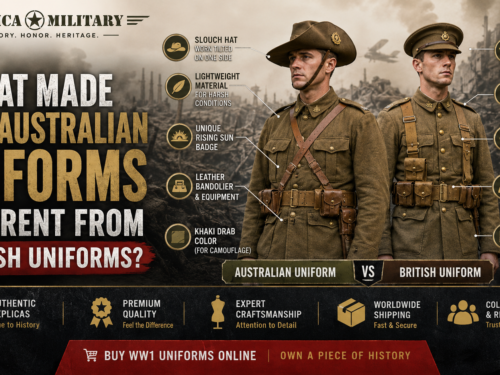
The most frequent type of personal modifications to Australian WW1 dress was to alter the fit. Soldiers modified their tunics through trimming sleeves or altering the waistlines. The modified tunics of Australian soldiers enhanced their mobility and comfort, particularly during heat. The frontline uniforms of Australia during WW1 transformed the rigid ww1 australian uniform into something useful.
Webbing and Equipment Placement
Modified webbing and gear positions The WW1 war was not the only time for adjustments. Soldiers changed the arrangement of ammunition pouches and water bottles to facilitate access. Pockets that were custom-designed for Australian WW1 uniforms were introduced or reinforced to show how personal modifications to Australian WW1 dress directly aided in the battle’s efficiency.
Insignia and Identity
Personalized emblems on Australian WW1 dress allowed soldiers to display their identities. The badges that were not official were worn by ANZAC soldiers, as well as unit-identity-driven uniforms from WW1, which appeared regularly. These deviations from the norm of Australian WW1 uniforms helped maintain morale within the overall framework of the WW1 Australian uniform.
Why Were Personal Modifications Necessary?
Climate and Environment
Climate-driven uniform changes in WW1 Australia were not a choice. In Gallipoli and Gallipoli, the Middle East, and parts of the Western Front, heat caused discomfort and sickness. Soldiers responded by implementing personal modifications to Australian WW1 dress which reduced the weight of the fabric and enhanced airflow. The Australian WW1 field-modified uniforms were practical responses to harsh environments.
Combat Conditions
Trench warfare required the flexibility. Rain, mud, and continuous movement damaged clothing rapidly. Repairs made by hand to Australian WW1 clothing were commonplace, and patches and reused uniforms from WW1 Australia were frequent. Modified uniform repairs in the frontline wartime allowed soldiers to continue working in the event that replacements were not available and emphasized the necessity of personal modifications to Australian WW1 dress.
Supply Shortages
Lines of uniform supply were stretched. The delays forced soldiers to use everyday soldiers’ modifications to WW1 Australian uniforms. Reuse, repair and adaptation made sure that the uniforms of the WW1 Australian soldiers were able to be used for many years beyond the expected lifespan.
How Were Uniforms Modified in Practice?
Tools and Techniques
The majority of personal modifications to Australian WW1 dress were completed using simple tools. Thread, needles and spare fabric were coveted. Soldiers mastered basic tailoring skills that allowed them to make adjustments to their clothing during the war of 1914, even when under fire.
Informal Knowledge Sharing
Modifications were spread through observation and guidance. One soldier’s method changed to another’s routine. As time passed, this frontline adaptation of the Australian WW1 uniform created an unofficial culture surrounding that ww1 Australian uniform, mixing the rules with actual experience.
Acceptance by Command
Although officially forbidden, many officers were able to tolerate personal modifications to Australian WW1 dress. Insofar as function and discipline were maintained and uniformity was maintained, any deviation from standard-issue Australian WW1 uniforms was overlooked.
When Did These Modifications Become Common?
Early War Adjustments
From 1914 to 1915, Australian troopers began to adapt the WW1 Australian uniform. The initial enthusiasm for the uniform waned quickly in the midst of battle and made personal modifications to Australian WW1 dress an absolute necessity, not an option.
Mid to Late War Normalization
Between 1916 and 1918, the modifications were widely used. Australian WW1 uniforms that were modified for field use were the norm, not the only exception. In this period, personal modifications to Australian WW1 dress were part of everyday military daily life.
The Broader Meaning of Uniform Modification
Practical Survival
At the core, personal modifications to Australian WW1 dress were all about the survival of the fittest. Mobility, comfort and durability were more important than the appearance. Every change resulted in the ww1 australian uniform more suited for battle.
Identity and Morale
The uniforms also showed the individuality of each. Individualized insignia on Australian WW1 dress and unofficial badges worn by ANZAC soldiers increased pride for the unit. These uniform changes based on identity in WW1 made it easier for soldiers to form bonds.
Historical Insight
The present day is when historians examine personal modifications to Australian WW1 dress to gain insight into real soldier experiences. These modifications show the way that official military systems changed under stress, providing an empathetic view of the ww1 australian uniform.
Conclusion
The australian uniform from the war of 1914 was not only a uniform. Through continual wear, repair and modification, it was transformed into personal tools that were shaped through necessity. personal modifications to Australian WW1 dress show how soldiers crossed the gap between their military expectations and the battlefield. From the climate-based changes to uniforms in WW1 Australia to the improvised uniform repairs on the WW1 front line, these practices determined the way Australians were fighting and living through the First World War.
To explore more about military uniform so connect with our facebook.
Top 5 FAQs Based on Common Google Searches
1. What was the reason Australian soldier’s uniforms change during World War 1?
Australian soldiers created personal modifications to Australian WW1 dress due to the climate conditions, combat, and supply shortages, making the standard uniforms unsuitable.
2. Are uniform modifications allowed in the law?
The majority of personal modifications to Australian WW1 dress were not official and were usually accepted when they enhanced function and didn’t affect the discipline of the soldiers.
3. What elements from the WW1 Australian uniforms were the most modified?
Webbing, turban pockets, insignia, and turbans were frequently changed with personal modifications to Australian WW1 dress.
4. Have all Australian soldiers alter their uniforms?
There are many; however, a lot were involved in personal modifications to Australian WW1 dress and uniforms, particularly frontline soldiers exposed to harsh environments.
5. What are historians’ methods of studying modern-day uniforms?
Researchers study diaries, photographs and other preserved ww1 australian uniform examples to better understand the personal modifications to Australian WW1 dress and soldiers’ lives.